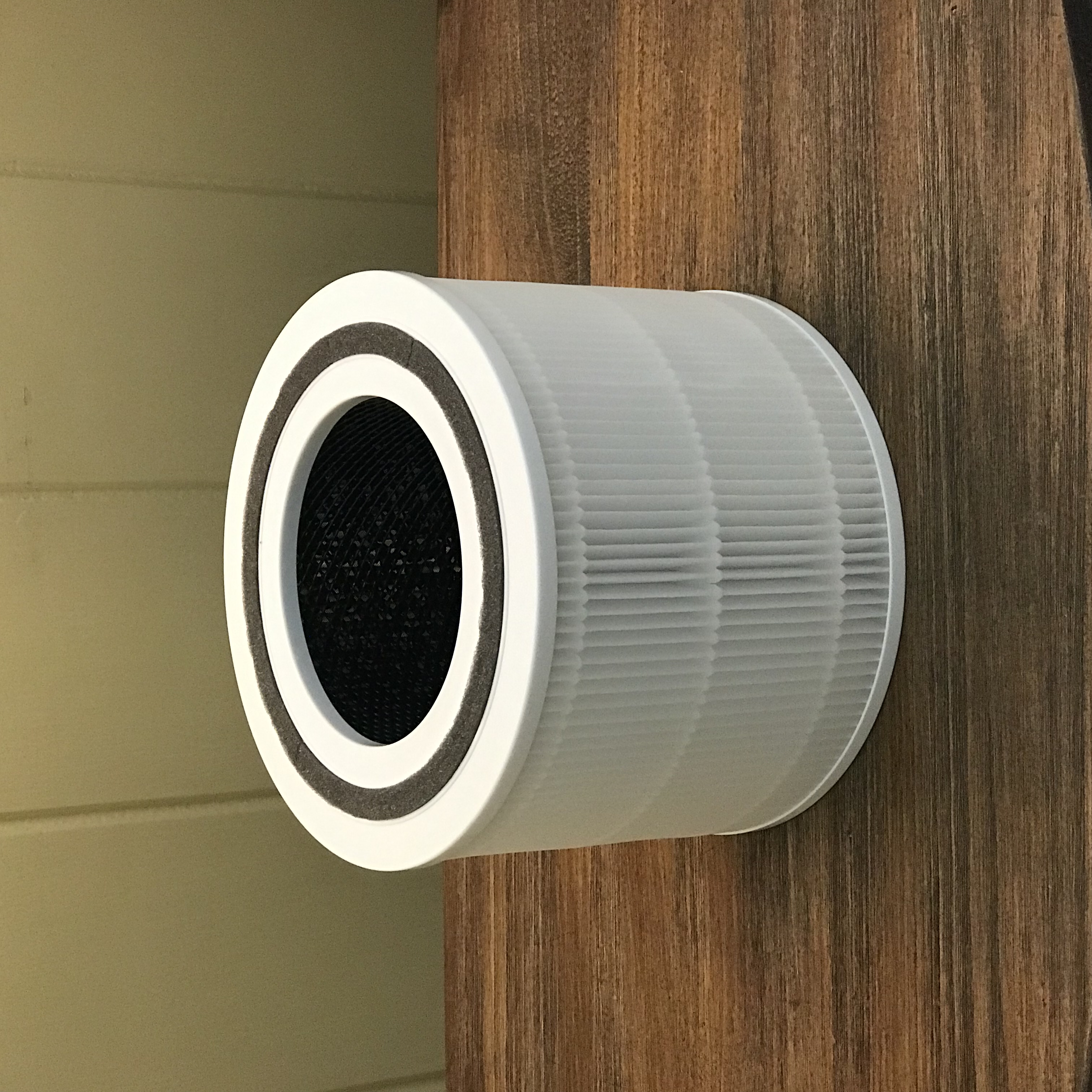
Not all air filters perform the same work. A standard fibreglass furnace filter and a HEPA-certified unit in a portable purifier differ by several orders of magnitude in what particle sizes they capture and at what efficiency. Understanding the rating systems behind these products clarifies which filter type is appropriate for a given application — and which common marketing claims are more assertion than specification.
The MERV Rating System
MERV stands for Minimum Efficiency Reporting Value. It is defined by ASHRAE Standard 52.2 — Method of Testing General Ventilation Air Cleaning Devices for Removal Efficiency by Particle Size. The scale runs from 1 to 20, with higher numbers indicating greater removal efficiency across smaller particle size ranges. The test measures performance across three particle size ranges: 0.3–1.0 µm (E1), 1.0–3.0 µm (E2), and 3.0–10.0 µm (E3). The composite result is assigned a MERV value.
| MERV Range | What It Captures | Typical Application |
|---|---|---|
| MERV 1–4 | Pollen, large dust, carpet fibres (>10 µm) | Protecting HVAC equipment; pre-filters |
| MERV 5–8 | Mould spores, dust mite debris, pet dander (3–10 µm) | Standard residential furnace filters |
| MERV 9–12 | Legionella, lead dust, humidifier dust (1–3 µm) | Superior residential and light commercial |
| MERV 13–16 | PM2.5, smoke, bacteria (0.3–1.0 µm) | Hospital-adjacent settings; smoke event protection |
| MERV 17–20 | Virus carriers, carbon dust (<0.3 µm) | Clean rooms, pharmaceutical, medical |
For residential use, most HVAC systems are designed around MERV 8 filters. Upgrading to MERV 11 or MERV 13 provides meaningfully better capture of PM2.5-range particles without necessarily causing significant problems, depending on the system. However, this requires verification: not all residential air handlers have the fan capacity to maintain adequate airflow through a denser filter medium.
Static Pressure and Airflow Trade-offs
Every filter introduces resistance to airflow, measured as static pressure drop. As MERV rating increases, so does the pressure drop for a given filter area. A furnace or air handler has a rated external static pressure limit. If a high-MERV filter exceeds this limit, airflow through the system decreases — which reduces heating and cooling distribution efficiency and, paradoxically, can reduce filter effectiveness by allowing more air to bypass through gaps around the filter frame.
A partial remedy is to use a filter with greater face area. Larger or pleated filter designs offer more filtration media in the same nominal frame size, reducing velocity through the media and therefore lowering the pressure drop at a given MERV rating. 4-inch or 5-inch deep media filters in MERV 11 to 13 range are available for many standard residential systems and present a reasonable balance between filtration performance and pressure constraints.
The HEPA Standard
HEPA — High Efficiency Particulate Air — is a performance specification rather than a brand or MERV rating. A true HEPA filter must remove at least 99.97 percent of particles at 0.3 micrometres (the most penetrating particle size for fibrous filters, known as the MPPS). This corresponds roughly to MERV 17 on the ASHRAE scale, far above the practical range of residential central systems.
HEPA filters are standard in portable room air purifiers. They are not practical for installation in most residential forced-air systems: the filter area required to achieve acceptable airflow at HEPA efficiency typically exceeds what standard duct configurations accommodate, and the pressure drop would overwhelm most residential furnace blowers.
True HEPA vs. HEPA-Type
The term "HEPA-type" or "HEPA-style" has no standardized technical definition. Products labelled this way may capture significantly fewer particles than a tested and certified HEPA filter. Certifications from organizations such as AHAM (Association of Home Appliance Manufacturers) or specific performance claims tied to a tested removal efficiency percentage are more meaningful indicators than "HEPA-type" labelling alone.
Activated Carbon and Gas-Phase Pollutants
Particulate filters — whether MERV-rated media filters or HEPA — do not capture gases or vapours. VOCs, formaldehyde, nitrogen dioxide, and odour molecules pass straight through a fibrous filter. Activated carbon (also called activated charcoal) addresses this by adsorption: gas molecules bond to the large internal surface area of the porous carbon material and are held there until the carbon is saturated.
The capacity of activated carbon is finite. Once saturated, it no longer adsorbs additional contaminants, and in some conditions can begin to release previously captured compounds — a process sometimes called off-gassing from the filter itself. For routine residential use with low ambient VOC concentrations, activated carbon filters in combined HEPA+carbon purifiers typically provide useful service for three to six months before replacement is recommended. In environments with higher VOC loads — recently renovated spaces, homes with attached garages — the carbon reaches saturation more quickly.
The volume of carbon matters. A thin layer of carbon on the back of a HEPA filter provides only limited capacity compared to a thick granular activated carbon bed. Products that specify carbon weight (grams or kilograms) alongside the HEPA element provide better information for assessing gas-phase performance.
CADR and Room-Sized Portable Purifiers
CADR — Clean Air Delivery Rate — is a metric defined by AHAM that quantifies how quickly a portable air purifier reduces particle concentration in a test room. It is expressed in cubic feet per minute (CFM) or cubic metres per hour (m³/h) for three particle types: tobacco smoke, pollen, and dust. A higher CADR indicates faster air cleaning for that particle type.
The AHAM CADR sizing rule of thumb — that a purifier's CADR for smoke should be at least two-thirds of the room area in square feet — provides a starting point for matching a unit to a space. During wildfire smoke events (increasingly relevant across western Canada), running the purifier at higher speeds and reducing outdoor air intake through the ventilation system are common guidance points from provincial health authorities.
Filtration in the Canadian Context
Wildfire smoke events have become a recurring consideration in several Canadian regions. During such events, outdoor PM2.5 concentrations regularly exceed levels considered safe for extended outdoor exposure. For homes with central HVAC systems, installing a MERV 13 filter during smoke events and reducing the outdoor air fraction of the ventilation system (if controllable) can reduce indoor PM2.5 infiltration meaningfully. Where the HRV or ERV has a bypass or recirculation mode, operating it in recirculation mode during severe smoke events limits outdoor air intake.
Allergy-related particulates — pollen, pet dander, dust mite allergens — are generally in the 2 to 10 µm range, where MERV 8 through MERV 11 filters provide good capture efficiency. For households where allergy management is a priority, upgrading from a MERV 4 or 6 filter to a MERV 11 is often the most practical and cost-effective step available within the constraints of an existing central system.
ASHRAE Standard 52.2, the foundational MERV test method, and AHAM's CADR certification process are the primary standards referenced when evaluating residential filtration products. Filter manufacturers publish data sheets showing pressure drop versus airflow for specific models, which is necessary information for verifying compatibility with a given HVAC system.
Practical Summary
Central system filters in the MERV 8 to 13 range suit most residential applications, with the upper end appropriate during events involving elevated PM2.5. HEPA filtration belongs in portable purifiers rather than central systems for typical residential configurations. Activated carbon addresses gas-phase pollutants that fibrous filters cannot capture, with capacity proportional to the carbon volume in the unit. Matching filtration to the actual pollutants of concern — rather than selecting the highest-rated product available — is the more productive approach, particularly where system airflow constraints apply.